In-situ U-value measurement on a PScoat wall: what it shows, what not
Jump through this article
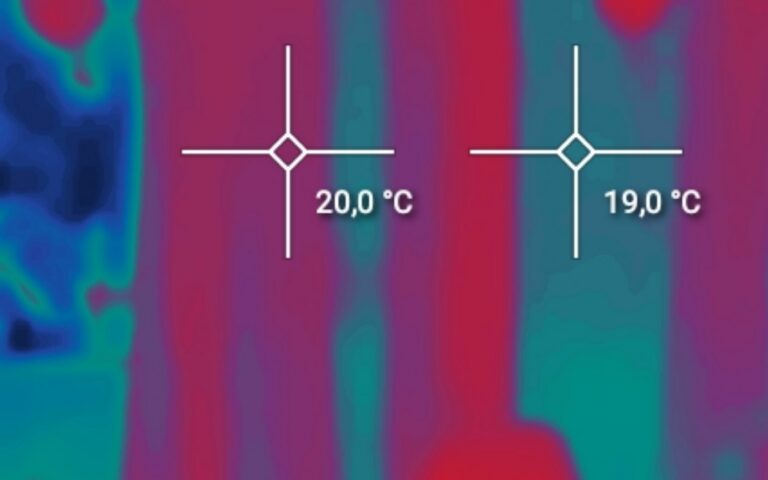
On 6 and 7 September 2026, the U-value was recorded for almost twelve hours on a historic solid wall with a PScoat coating of around 0.5 mm. For a two-hour evaluation window, the supplier’s measurement report PSC-U-2026-001 gives a mean value of 0.140 W/(m²K). The report discloses the measurement set-up and boundary conditions.
Object measured and measurement set-up
| Object measured | historic solid external wall, coated in April 2025; measuring point in a normal wall area, about 1 m beside a window |
|---|---|
| Wall build-up, outside to inside | PScoat coating, approx. 5 mm reinforcing mortar with mesh, cement or lime-cement render, three-layer solid brick masonry, inside cement render with acrylic wall paint |
| Coating | approx. 0.5 mm; according to the report “Basic B + PSC Build (version 2024)”, approx. 18 l on approx. 35 m² |
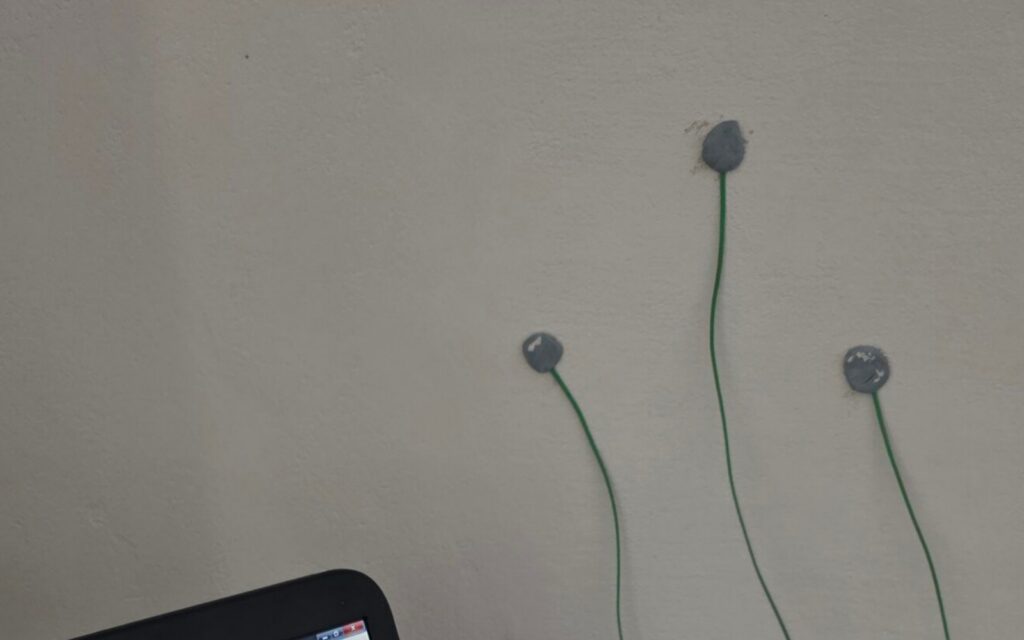
| Measuring system | Testo 635-2 with U-value kit, continuous recording |
| Period | 6 September 2026, 20:57 to 7 September 2026, 08:54 (11 h 57 min), 42,978 evaluable data records |
| Boundary conditions | Heating off, windows closed, no movement of people in the room after 23:00; room temperature at the start about 26 °C |
| Quantities measured | Temperature of the inner wall surface, of the indoor air and of the outdoor air |
What was measured
| Evaluation window | Mean | Median | Std. dev. | Min. | Max. |
|---|---|---|---|---|---|
| 01:15–03:15 | 0.140 | 0.139 | 0.016 | 0.111 | 0.177 |
| 05:00 to end of measurement | 0.195 | 0.183 | 0.044 | 0.105 | 0.293 |
All values in W/(m²K), source: table in the measurement report. The start of the recording is not included: the outdoor sensor was initially still inside the room, so the calculated U-value was far too high. The report treats this phase as a set-up phase and not as a result for the wall.
The figure therefore depends on the evaluation window chosen: 0.140 W/(m²K) in the first, 0.195 W/(m²K) in the second evaluation phase.
The derived lambda comparison value
From the U-value, the report back-calculates an equivalent thermal conductivity value for the coating. As the starting value for the wall it uses U = 1.60 W/(m²K), a “usual, technically plausible reference value”.
The worked example in the report uses U = 0.20 W/(m²K): total resistance 5.000 m²K/W, minus 0.625 m²K/W for the uncoated wall, leaves 4.375 m²K/W; divided by the thickness of 0.5 mm this gives about 0.000114 W/(m·K). The direct back-calculation yields 0.000077 W/(m·K) from the first and 0.000111 W/(m·K) from the second window. The report rounds to about 0.0001 W/(m·K) and makes clear that this value is not a material property determined in a laboratory.
In calculation terms, λ = d / ΔR: with the same measured additional resistance, the value for a layer twice as thick would be twice as high. Such a comparison value therefore always belongs to the thickness examined and the building element examined.
Assessment
The report documents one wall over almost twelve hours and presents itself as a technical evaluation; it does not replace an accredited laboratory test, certification or building-authority assessment. The report recommends that any transfer to other wall build-ups be checked technically. How in-situ measurements are to be classified in principle is described, for thermography, in the article What a thermal image proves – and what it does not.
Sources
- PScoat – In-situ-U-Wert-Messung, Technischer Messbericht PSC-U-2026-001 (in-situ U-value measurement, technical measurement report) – measurement series 6/7 September 2026
- Wirkprinzip: Strahlung statt Dämmstoffdicke (principle of operation: radiation instead of insulation thickness) – accessed 30 October 2026
- PScoat Nachweise (evidence): test reports, measurements, certificates – as at 12 October 2026
- Systemhandbuch PSC-FAS-001 Nanofassadendämmung (system manual, nano façade insulation) (Fassade) – version 1.0, June 2026 edition
- Hauser/Kersken/Schade/Sinnesbichler: Experimentelle und theoretische Untersuchungen von Infrarot reflektierenden Dämmmaterialien (experimental and theoretical investigations of infrared-reflective insulation materials), Bauphysik 33 (2011), issue 1 – Bauphysik 33 (2011), issue 1, pp. 33–42