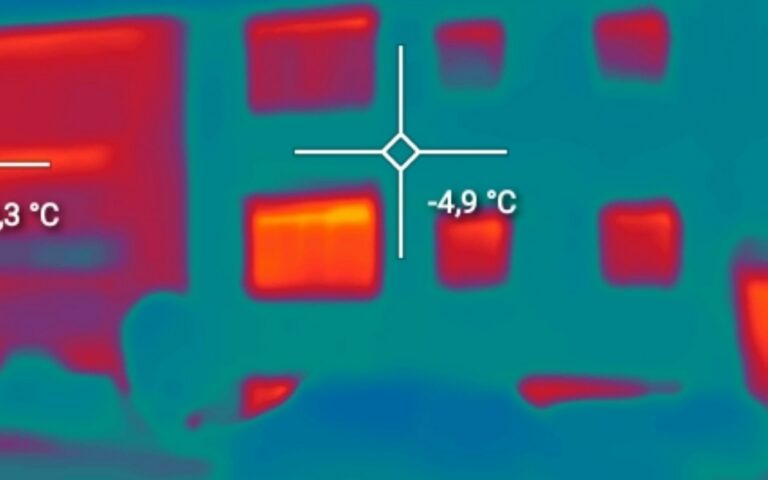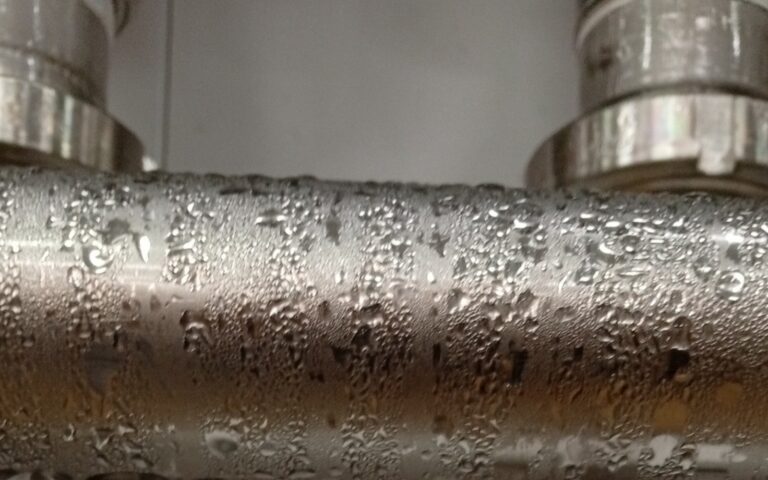
Below the dew point at night: condensation and algae on insulated façades
Jump through this article
Algae on a freshly insulated façade look like an insulation defect. In terms of building physics, it is a surface problem: the thin outer layer of an external thermal insulation composite system (ETICS) is thermally decoupled from the warm masonry and cools towards the night sky. BauNetz Wissen notes that the damage has no effect on the effectiveness of the insulation systems; visually, however, it is often considerable.
What happens at the outer surface at night
An ETICS thermally shields the solid building elements. Because it has no storage mass of its own, the façade cools at night, mainly through radiation, to below the air temperature, and condensation forms. According to the Fraunhofer IBP (Fraunhofer Institute for Building Physics) investigations in Bausubstanz 2/2018, clear nights are decisive for this; the nocturnal shortfall below the dew point is often only a few tenths of a degree.
In 2001, the Fraunhofer IBP re-evaluated outdoor measurements on a test house from autumn 1994. The west wall had 80 mm ETICS on 240 mm sand-lime brick (U = 0.41 W/m²K); the comparison walls consisted of 365 mm porous lightweight clay block (U = 0.51 W/m²K). The months of September and October were evaluated.
Result: the surface temperature of the ETICS fell below the outside air temperature through nocturnal radiation, whereas that of the south-facing monolithic wall stayed above it. Frequent nocturnal condensation was to be expected only with the ETICS, and with the monolithic walls only in exceptional situations.
From condensation to algal film
Microorganisms settle when the surface is permanently damp, and according to BauNetz Wissen this moisture arises predominantly through dew formation. According to current knowledge, what matters is not the amount of condensation but the water available on the surface to the microorganisms, at least for the onset of growth. The critical season is autumn; in winter it is too cold, in summer too dry. According to the IBP, condensation in many cases leads to infestation only in combination with adhering rainwater; dew formation and driving rain therefore add up.
- North and west sides are particularly susceptible. According to the IBP, the fact that the north side, which receives little driving rain, is also affected is explained only by nocturnal dew formation.
- Water-repellent top-coat renders do not absorb the water; it forms droplets and dries off very slowly.
- Above a plastic fixing, higher heat flows occur and the render surface dries faster there. Algae lack the basis for life at this point, and the fixings show through.
- According to the IBP calculation, the duration of dew formation could be shortened significantly only with insulation thicknesses below 8 cm, which the authors consider unenforceable.
At the same time, most ETICS as built remain free of damage. Only a small percentage show growth that gives cause for complaint.
What planners know as countermeasures
| Approach | Principle | Assessment |
|---|---|---|
| Biocides in render and paint | kill microorganisms | Active substances wash out and burden the environment; effectiveness is limited on the weather side |
| Thicker, hydrophilic mineral render | more storage mass; hydrophilic renders absorb moisture immediately | Measurement after a clear night: almost twice as much water on standard ETICS with white paint as on white thick-layer render; calculated dew-point undershoot at most 20% shorter |
| Darker colour shades | more radiation gain during the day | calculated, the dark façade falls below the dew point at almost the same time as the white one; masks slight growth |
| Latent heat storage (PCM) | discharge as temperature falls delays condensation | calculated up to 70% less dew-point undershoot, effective in outdoor conditions only in some years |
| Superhydrophobic silicone resin paint | water beads off | IBP test areas after three years: algal growth not detected, slight with other biocide-free products |
| Low-emissivity (IR-reflective) paints | smaller nocturnal temperature drop | see below |
| Roof overhangs | less driving rain | to be decided in line with the design concept |
The percentage figures cannot be compared with one another. The values for thick-layer render, IR paint and latent heat storage are calculated effects for the period from September to October; the measured value for the thick-layer render comes from a morning after a clear night. Anyone assessing a measure should therefore ask about boundary conditions and orientation, not about the biggest number.
Low emissivity: what was measured
The idea is simple in physical terms: reduce the long-wave radiation and you reduce the nocturnal temperature drop. The IBP calculation assumes an emissivity of 0.6 instead of 0.9; in the clear September night considered, the calculated surface temperature of the ETICS always stayed above the dew point temperature. What emissivity actually means for building elements is explained in the article What emissivity describes.
In outdoor tests, early paints showed around 50% less condensation on the west façade, but after a few months lost their appearance through weathering of the aluminium flakes and turned silvery. Two further developed systems, applied at the end of 2011 and three years later, were tested on the west and north walls.
On the north wall, the beige-grey system shortened the duration of dew formation in the autumn periods, apart from the first, by about 25%, and the blue-grey system by 10 and 18%. After two years of weathering, the blue-grey system showed no silvering effect. The authors conclude that a reduction of about 25% could avoid most problems. One of the four authors is technical director of a paint factory.
The limits of assessing exterior surfaces with a thermal imaging camera are explained in the article What a thermal image proves.
What remains open
BauNetz Wissen notes that the development of suitable measures against algal and lichen infestation is not complete. The IBP data are measurement series at one location in individual autumn periods; effectiveness depends on the system, the orientation and the year’s weather. For planning, this means that a single measure does not eliminate the risk; it reduces the duration of dew formation and the supply of water. What remains open above all is which of the approaches prove themselves on real façades over ten years and more.
Anyone measuring on site must know the order of magnitude: with a shortfall of a few tenths of a degree, measurement accuracy decides what the result can say. For its outdoor measurements, the IBP calibrated each sensor individually before installation.
Sources
- Grauschleier an Fassaden (grey haze on façades; BauNetz Wissen Dämmstoffe) – page without date; accessed 30 October 2026
- Algen auf Wärmedämm-Verbundsystemen (algae on external thermal insulation composite systems), IBP-Mitteilung 382 (Fraunhofer IBP) – 28 (2001), new research results in brief; measurement period 16 September to 24 October 1994
- Einsatz eines neuen wetterresistenten IR-Anstrichs im Vergleich mit anderen Maßnahmen zur Reduktion des Bewuchsrisikos an Außenfassaden (use of a new weather-resistant IR paint compared with other measures to reduce the risk of growth on exterior façades) (Krus, Thiel, Born, Fitz; Bausubstanz 2/2018, Fraunhofer IBP) – Bausubstanz 9 (2018), issue 2 (April), pp. 35–43; measurement series 2012 to 2015
- Wärmebrücken: Arten (thermal bridges: types; BauNetz Wissen) – page without date; accessed 30 October 2026